SEO vs Google Ads: Where Should Your First Marketing Dollar Go?
SEO vs Google Ads: Where Should Your First Marketing Dollar Go?
It’s a week before Durga Puja, your shop or business is ready, the festive offer is finalised, and the stock is in. Then someone in your team asks, “Sir, online promotion kaise karenge?” Now you’re stuck between two options: spend on Google Ads and get customers right now, or invest in SEO and wait for results that last longer. Both sound good, and both have a friend who swears by them.
So which one deserves your first marketing dolar? Let’s sort this out in plain language, without the jargon.
What is SEO, in simple words?
SEO (Search Engine Optimization) is the work you do so that your website shows up on Google natura ly , without paying for each click. When someone searches “best interior designer in Howrah” or “buy industrial valves online”, Google picks a handful of pages to show first. SEO is how you earn a place among them.
It covers a lot of smal things: writing useful pages, using the words your customers actualy type, making your site fast on mobile, fixing your Google Business Profile, and getting other trusted websites to mention you. None of this is magic. It is steady, boring, useful work, and that’s exactly why it pays off.
The best part is that organic traffic doesn’t charge you per visit. Once a page ranks, it can keep bringing visitors month after month. The catch is time. SEO is not an overnight thing, and anyone promising “page one in 7 days” is seling you a dream.
What are Google Ads, in simple words?
Google Ads is the paid side. You pick the keywords you want to show up for, set a budget, write a short ad, and Google shows it at the top of the results. You pay when someone clicks (that’s why it’s ca led pay-per-click, or PPC).
The big advantage is speed. You can launch an ad in the morning and start getting enquiries by the evening. You also get tight control: you choose the city, the time of day, the device, even the budget per day. If you want to promote a Navratri sale that ends in nine days, this is the tool that actua ly fits that deadline.
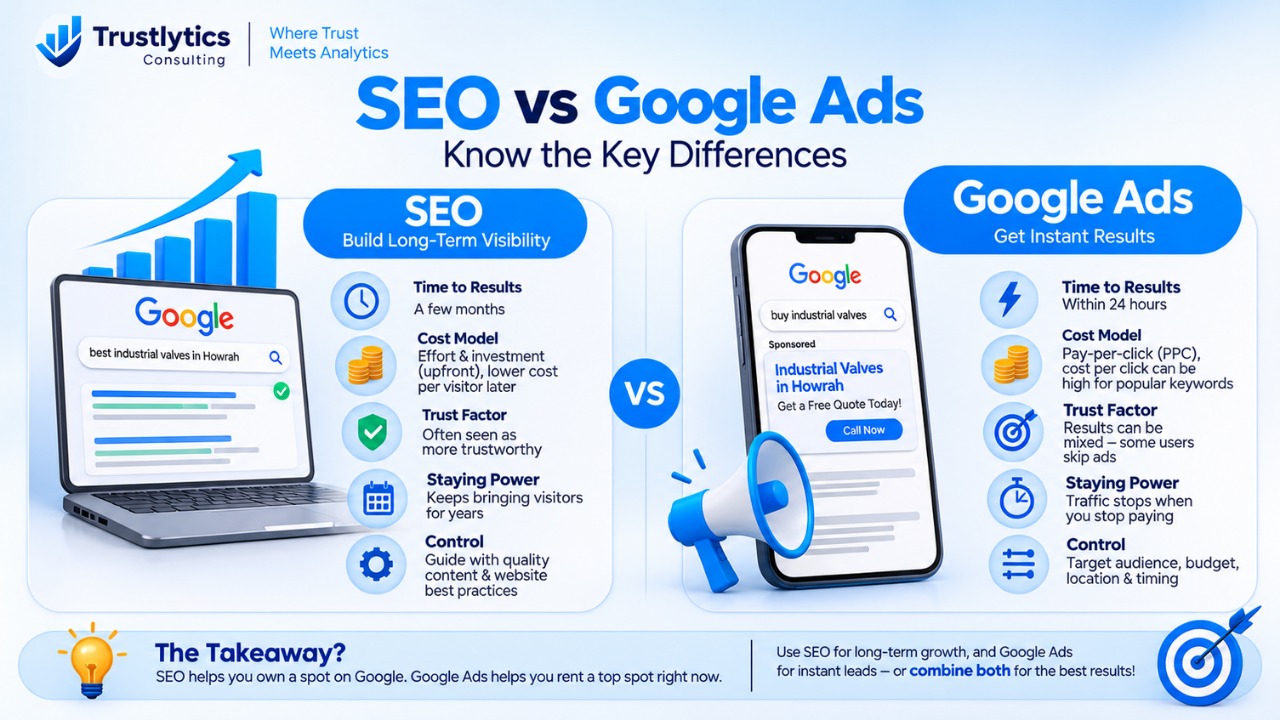
The catch? The moment you stop paying, the traffic stops. Ads rent you a spot on the shelf. SEO helps you own a bit of the shop.
SEO vs Google Ads: the real differences
Let’s put the two side by side, in the way a business owner actualy thinks about it.
Speed. Google Ads wins. You can be live within a day. SEO usualy takes a few months before you see steady movement, and the exact time depends on your industry, competition and the current state of your website.
Cost over time. Ads cost you every single click, and popular keywords can get pricey, especia ly in competitive fields like real estate, education, finance or healthcare. SEO costs effort and money upfront (content, fixes, tools or an agency), but the cost per visitor tends to fa l as your pages mature.
Trust. Many people scrol past the ads on purpose. Organic results often feel more trustworthy because the page earned its position. That said, a sharp ad for exactly what someone searched can sti l convert beautifully.
Staying power. A good blog or service page can keep working for you for years. An ad campaign gives you results only while the budget is running.
Control. Ads give you more control over who sees what and when. SEO is influenced by Google’s algorithm, so you guide it rather than command it.
Neither is “better”. They answer different questions. Ads answer, “How do I get leads this week ?” SEO answers, “How do I stop depending on paid clicks next year ?”
So where should your first marketing dollar go?
Here’s the honest, slightly annoying answer: it depends on your situation. But we can make it very simple by looking at three things.
1. How fast do you need customers? If your cash flow needs enquiries now (a festive sale, a new launch, a seasonal service), start with Google Ads. Waiting for SEO while rent and salaries are due is not a strategy.
2. Is your website ready? This is the part most people skip. If your website loads slowly, looks broken on mobile, or has no clear “Cal us” or “Get a quote” button, then pouring money into ads is like filing a bucket with a hole in it. You’ l pay for clicks and visitors wi l leave. Fix the basics first, whichever route you choose.
3. How big is your budget? With a very smal budget, ads can burn through money fast, especialy if your keywords are broad. A tight, local campaign works better than a wide, vague one. If you can only spend a little, a smart mix of local SEO (like a wel-set-up Google Business Profile, which is free) and a smal, focused ad budget often gives the best return for a smal business.
A simple rule of thumb: need leads this month → start with Ads. Building for the long run → start with SEO. Can afford both → run them together, with the smaller share going to whichever you’re less sure about.
Why the Durga Puja and Navratri season changes the math
Festive season is when search behaviour changes completely. People look for gifts, new clothes, home décor, electronics, sweets, catering, travel, salon bookings and “offers near me” in huge numbers. Searches like “Durga Puja offers”, “Navratri sale” or “festive discount” jump up, and every competitor wakes up at the same time.
That creates two realities.
First, ad costs can go up in busy weeks because more businesses are bidding for the same attention. If you jump in at the last minute with no plan, you may pay more per click than you expected. A tight budget, specific keywords (like “Durga Puja offer on [your product] in Kolkata” instead of just “sale”) and a landing page that actua ly shows the offer wil protect your money.
Second, this is the best time to plant SEO seeds . A page about your festive offer, a gift guide, a “how to choose” article, or a post answering common customer questions can start colecting traffic now and keep helping next season. Many businesses forget that festivals come back every year. A page you build this Puja can rank better by next Navratri, if you keep it updated.
So if your festive window is already running, put a smal, focused ad budget behind your best offer and start building the pages that wi l help you for the next festival too. That’s the smart way to think about it: ads for today’s sales, SEO for tomorrow’s.
A quick example for a local business
Let’s say you run a home-furnishing store in Howrah. Durga Puja is close, and you have a 20% off offer on sofas and curtains.
With Google Ads, you can show an ad to people searching “sofa offer in Howrah” or “Puja discount furniture Kolkata”, send them to a page with the offer, a phone number and a WhatsApp button, and track every enquiry. You can switch it off the day the offer ends.
With SEO, you would set up your Google Business Profile properly (photos, timings, offer posts, reviews), write a helpful guide like “How to choose a sofa for a smal Kolkata flat”, and make sure your website loads fast on a phone. Nothing explodes overnight, but over a few months more people start finding you without you paying per click.
Do the first for this month’s sales. Do the second so that next year you aren’t starting from zero again.
Common mistakes small businesses make
Let me save you some money by listing the usual mistakes.
Running ads to the homepage. A visitor searching for one thing should land on a page about that thing. Otherwise they bounce, and you’ve paid for nothing.
Ignoring local search. For shops, clinics, service providers and local manufacturers, local SEO is often the cheapest win. A complete Google Business Profile with real photos and genuine reviews costs nothing but a little attention.
Chasing too many keywords. Start with the keywords that show buying intent, like “price”, “near me”, “buy”, “quote”, “supplier” or “best”. Those people are closer to paying you.
Not tracking anything. If you can’t tel which click became a cal or enquiry, you’re guessing. Set up basic tracking from day one.
Expecting SEO to work like an ad. SEO is slower by nature. Judge it over months, not days, and judge ads over days, not months.
Switching strategy every two weeks. Whatever you pick, give it enough time and data before you decide it “doesn’t work”.
What about ROI?
Everyone wants to know which one gives better return on investment (ROI). The truthful answer is that it varies a lot by industry, budget and how wel the work is done. Ads can deliver a quick, measurable return if your offer is strong and your landing page is good. SEO often delivers a better return over a longer period because the traffic keeps coming without a fresh payment for every visit. Be careful of anyone who quotes you one fixed “ROI number” for either channel without knowing your business. Real numbers come from your own data, not from a general claim.
A simple plan you can follow
If you want a practical starting point, here is one that works for many smal businesses and MSMEs:
Month 1: Fix the basics. Make the website mobile-friendly and fast, add clear contact buttons, and complete your Google Business Profile. Launch a smal, local Google Ads campaign for your best-se ling product or current offer.
Months 2 to 3: Look at what the ads are teaching you. Which keywords bring real enquiries? Use those same words to create SEO pages and blog posts. Keep ads running on the winners, and pause the ones that drain money.
Months 4 to 6: As organic traffic starts to build, you can slowly reduce dependence on paid clicks for the keywords you now rank for, and move some budget to new products or new areas.
This way, ads give you quick learning and quick leads, and SEO turns that learning into a lasting asset. The two actualy help each other.
If you want one line: use Google Ads to get customers fast, and use SEO to keep getting them without paying every time. For your very first marketing dolar, pick based on your urgency. A festive sale with a deadline favours ads. A business that wants steady growth favours SEO. A smart business uses a bit of both.
The worst choice is doing nothing and hoping people wi l find you on their own, especialy in a season when your competitors are fighting for the same customers.
Frequently Asked Questions
Need help improving your Business Automation & growing your business?
At Trustlytics Consulting , we work with smal and medium businesses across Howrah, Kolkata and beyond, helping them with digital marketing, SEO, Google and Meta Ads, website development and business automation. We don’t believe in one-size-fits-al packages. We look at your business, your budget and your goals, and then tel you honestly where your money wil work hardest, whether that’s Durga Puja leads, Navratri offers or year-round growth.
If you’re planning your next campaign and want a clear, no-nonsense opinion, reach out to Trustlytics Consulting for a quick chat. Your first marketing do lar is precious. Let’s make sure it goes to the right place.