What is Business Automation?
Business automation is the use of technology, software, and digital tools
to automate repetitive business tasks and operational processes.
Walk into any manufacturing unit in Howrah or a growing trading business in Kolkata, and
you'll usually find the same story. Attendance is marked on a register. Inventory is tracked in
someone's memory (or a notebook that only one person understands). Sales numbers live in
three different WhatsApp groups, and nobody really knows the exact profit until the
accountant closes the books at month-end.
It's not that these businesses aren't capable. It's that they're running on guesswork instead
of data and for years, the systems that could fix this were priced for large corporations, not
for a Howrah-based valve manufacturer or a Kolkata retail chain with four outlets.
That's changing fast. In 2026, business automation software for small businesses has finally
become affordable, and MSMEs across India — including right here in Kolkata and Howrah
are catching up. A recent India SME Forum survey covering over 45,000 manufacturing and
service sector SMEs found rising adoption of AI powered tools for customer support, sales
forecasting, inventory optimization, and workflow automation. This isn't a big city, big budget
trend anymore. It's becoming table stakes for anyone who wants to stay competitive.
Where MSMEs See the Fastest Impact
1. Attendance and workforce tracking Manual registers are error-prone and nearly
impossible to audit. A simple automated system removes disputes over hours worked and
gives owners a clear picture of productivity without micromanaging.
2. Inventory and stock automation For manufacturers and traders especially, knowing
exact stock levels in real time prevents two expensive mistakes: overstocking capital into
unsold inventory, and understocking items that are actually selling.
3. Sales, profit, and cash-flow dashboards Instead of waiting for month-end reports,
owners get a live view of what's actually making money. This is often the single biggest
unlock — decisions that used to take weeks now take minutes.
4. Customer insight and retention tracking Understanding repeat-customer patterns,
order frequency, and drop-off points helps a business retain customers without spending
extra on ads to replace the ones it's quietly losing.
5. WhatsApp and communication workflows Automated order confirmations, delivery
updates, and follow-up messages free up hours every week — hours that currently go into
manually typing the same replies over and over.
The Trends Shaping Automation in 2026
- No-code automation means systems can be customized to your specific workflow
without needing a developer on payroll.
- Vernacular and voice-based tools are opening automation up to teams more
comfortable working in Bengali or Hindi than English — a big deal for Tier-2 and
Tier-3 businesses.
- Hyperautomation — connecting multiple small automations (attendance + inventory
+ sales) into one system — is replacing the old approach of buying separate,
disconnected software for each function.
- AI as a growth partner, not a luxury is the phrase industry bodies are using this
MSME Day, and it captures the shift well: automation is increasingly seen as
something that helps a five-person business compete with a fifty-person one, not just
a cost-cutting tool for large enterprises.
🚀 Key Benefits of Business Automation
Improved Productivity
Employees spend less time on repetitive tasks and more time on valuable work.
Cost Reduction
Automation lowers operational costs by reducing manual effort.
Better Accuracy
Automated systems reduce mistakes and improve process consistency.
Scalable Growth
Businesses can handle increased workloads without adding excessive resources.
Popular Business Automation Solutions
✅ CRM Automation
✅ Sales Pipeline Automation
✅ Lead Management Automation
✅ WhatsApp Business Automation
✅ Email Marketing Automation
✅ Reporting & Analytics Automation
✅ Task Management Automation
Common Myths That Hold Businesses Back
Small businesses often struggle with limited resources and time.
Business automation helps them compete more effectively by simplifying
daily operations and reducing administrative burdens."Automation is only for big companies." This was true a decade ago when enterprise BI
and ERP systems cost lakhs to implement. It isn't true anymore — that's the entire reason
affordable, MSME-focused automation exists today.
"Automation is only for big companies." This was true a decade ago when enterprise BI
and ERP systems cost lakhs to implement. It isn't true anymore — that's the entire reason
affordable, MSME-focused automation exists today.
"Automation is only for big companies." This was true a decade ago when enterprise BI
and ERP systems cost lakhs to implement. It isn't true anymore — that's the entire reason
affordable, MSME-focused automation exists today.
“Business automation is not about replacing people—it's about helping people work smarter and more efficiently.”
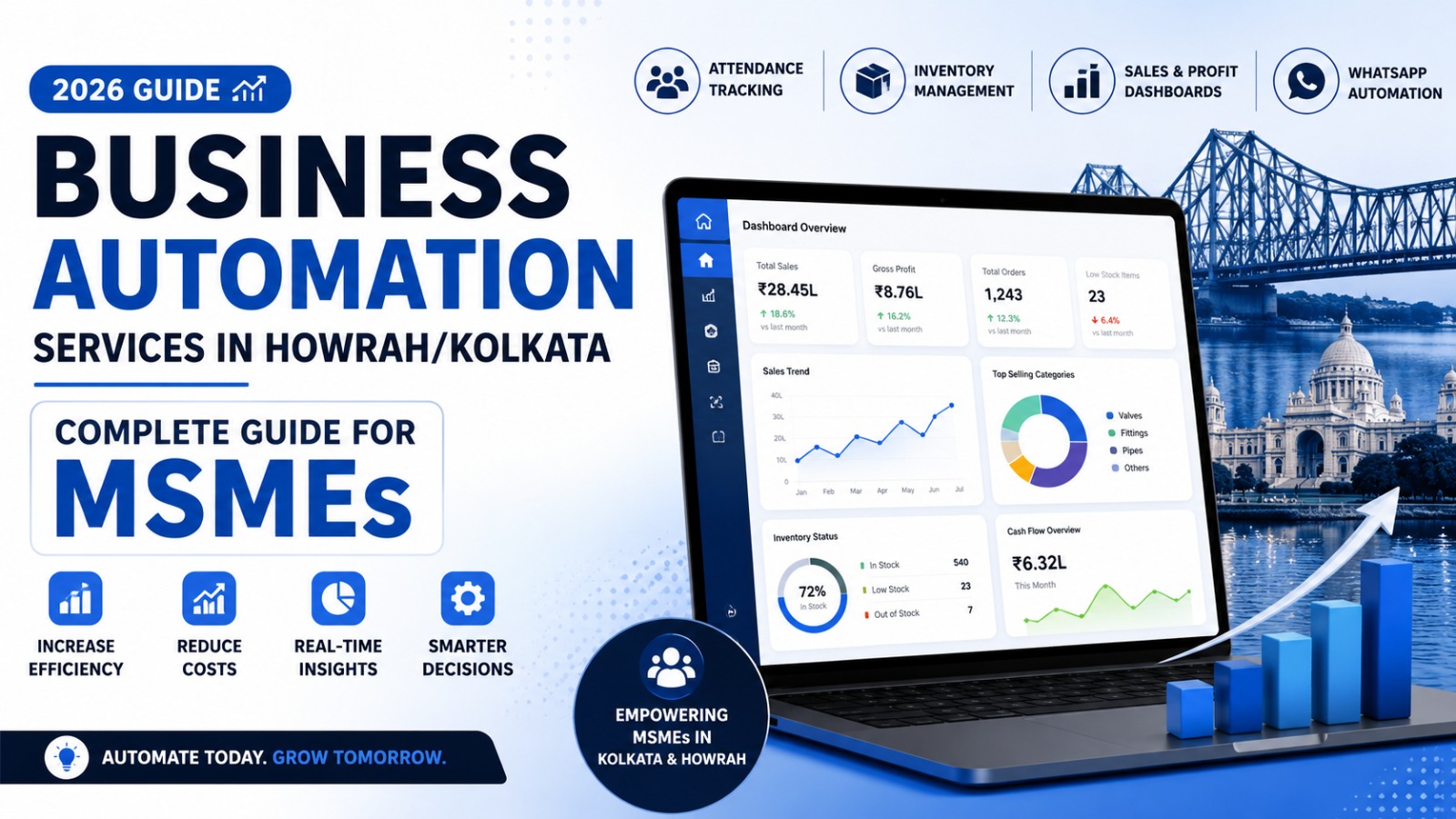
Choosing the Right Automation Partner in Kolkata or
Howrah
● Can they show you a live dashboard example, not just a slide deck?
● Do they build for your specific business (a valve manufacturer's inventory needs look
nothing like a retail store's), or do they sell the same template to everyone?
● Is pricing transparent and scaled for an MSME budget, or does it require an
"enterprise plan" to get anything useful?
● Do they understand your business's day-to-day reality — GST cycles, local vendor
relationships, seasonal demand — or are they applying a generic playbook?
Where Trustlytics Fits In
Trustlytics Consulting was built on exactly this gap. It started with one person and a laptop,
after seeing firsthand — working inside a company that ran its entire digital operations on
guesswork — how much small and growing businesses lose by not having the same data
tools that large corporations take for granted.
That experience shaped what Trustlytics does today: automation dashboards for attendance,
inventory, sales, and cash flow, AI-based predictive insights, and SEO-friendly websites, all
priced and built for businesses that are growing, not already at enterprise scale. The mission
is simple — technology should be a growth partner for MSMEs in Kolkata and Howrah, not a
luxury reserved for companies that can already afford it.