Is Your Kolkata Retail Store Ready for Festival Season?
Is Your Kolkata Retail Store Ready for Festival Season?
There's a particular sound Kolkata retailers wait for all year — the first dhaak beat drifting through the market lanes. It means the city is about to spend. Durga Puja alone generates an estimated ₹32,377 crore in economic activity for West Bengal, with retail as the single largest slice at roughly ₹27,364 crore, and sales spiking by around 100% during the festive window. Layer on Kali Puja and Diwali, where Kolkata's shopping has touched nearly ₹17,000 crore — up 16% on the previous year — and you're looking at the most valuable few weeks your business will see all year.
Here's the part most owners don't want to hear: that money doesn't automatically land in your till just because you're open longer hours. It goes to whoever the customer finds first, trusts fastest, and can actually be served without a queue, a stockout, or a billing headache. Increasingly, that's not the store with the loudest speaker outside — it's the one with its systems, its online presence, and its website quietly doing the heavy lifting behind the scenes.
Let's talk about what that actually looks like.
The Season That Forgives Nothing
Off-season, a few cracks in your operations barely show. A slow biller, a customer who "we'll add to the list later," an Instagram page that's gone quiet since March — none of it costs you much when footfall is thin. Festival season is a different animal. It doesn't create new problems; it just puts a magnifying glass over the old ones and turns up the pressure.
● A billing counter that can't move fast enough doesn't just annoy customers — during Puja week, it actively turns them away toward whichever shop next door has a shorter line.
● An inventory system that lives in someone's head guarantees you'll oversell your bestsellers and get stuck holding stock nobody wants, in the same week.
● A customer who isn't followed up on is a customer you paid to acquire once and will never see again — right when repeat business is easiest to win.
● A business that isn't searchable is invisible during the exact weeks when shopping lists are being written, weeks before anyone sets foot in New Market or Gariahat.
None of this is really an "online vs. offline" story. It's a readiness story. And readiness, this time of year, comes down to three things: automation that holds up under pressure, marketing that reaches people before they've already decided, and a website that does the convincing before they even arrive.
Business Automation — Because "We'll Manage" Isn't a Strategy
Automation has a reputation for being something only big retail chains need. In reality, it's the small and mid-sized store — the one without ten extra staff to throw at chaos — that benefits from it most.
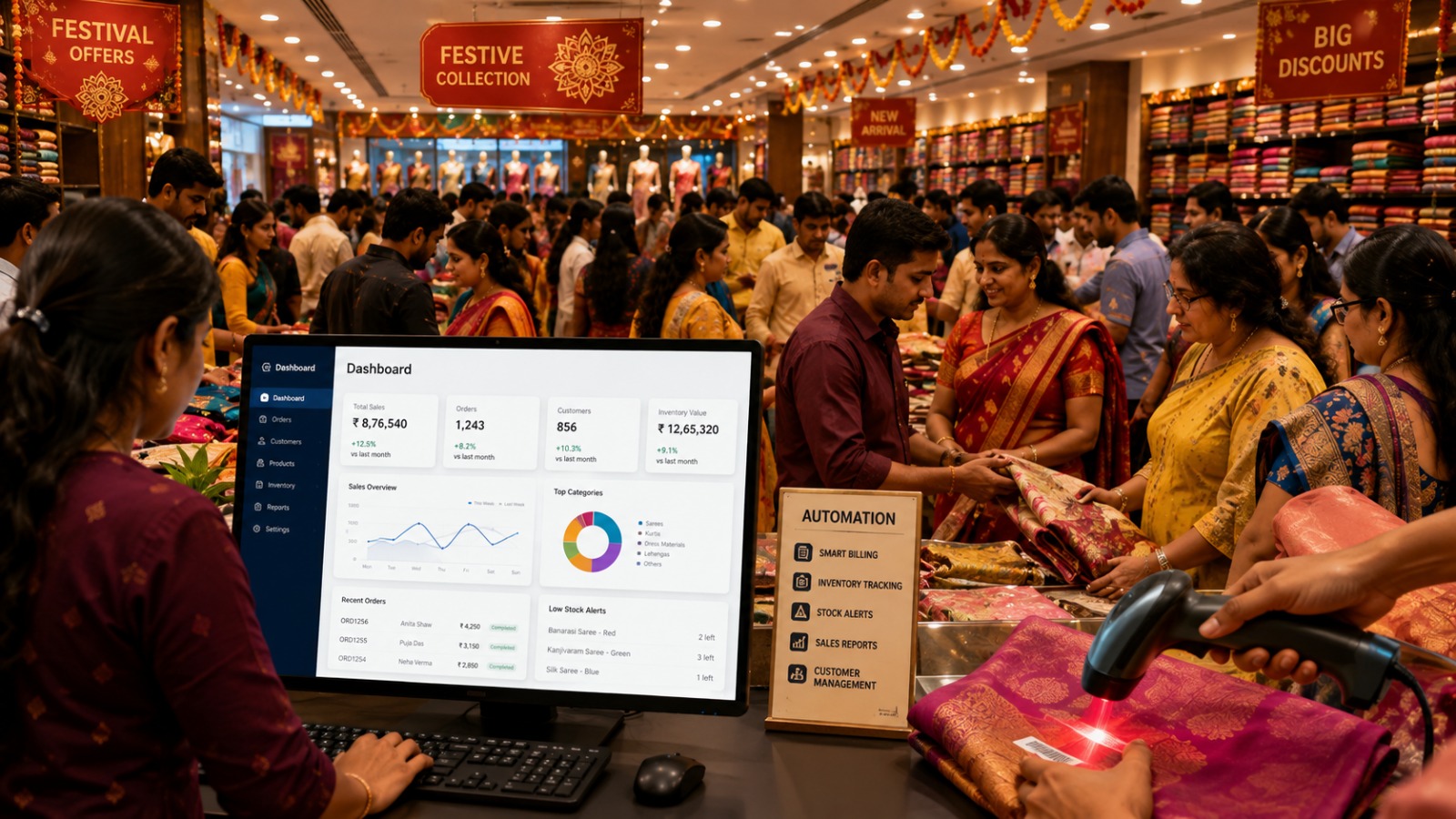
A real POS system turns a five-minute billing queue into a thirty-second one, keeps your GST compliance clean without extra effort, and gives you a live read on what's actually selling — not what you assume is selling.
Inventory management software is the difference between confidently telling a customer "yes, we have three left" and hoping you're right. During a week where a single Saturday can outsell an entire normal month, that confidence has a direct rupee value.
A lightweight CRM captures every festive walk-in as a name and number, not a missed opportunity — so the customer who bought once during Puja can be brought back for Diwali, and again after that.
WhatsApp and workflow automation handles the order confirmations, delivery updates, and thank-you messages your staff simply won't have time to send manually when the store is at its busiest.
None of this requires an enterprise budget. Dashboard-based automation covering billing, inventory, and customer data has genuinely become accessible for a single-outlet store in Howrah or Kolkata — not just the big regional chains.
Digital Marketing — Meeting Shoppers Before They've Made Up Their Mind
By the time a customer walks into your store during Puja week, they've often already decided where they're buying from. That decision was made online, weeks earlier, while they were scrolling — which means marketing that only starts in festival week is marketing that starts too late.
Meta Ads timed to the festive calendar — teaser content in early September, "new collection is in" pushes in late September, urgency-driven offers as Shashthi approaches — put your store in front of shoppers exactly when their plans are still forming, not after they've locked in.
Local SEO and an optimised Google Business Profile decide who wins the "saree shop near me" or "electronics store Howrah" search — often the single biggest source of walk-ins you're not currently tracking.
Bengali-first, hyperlocal creative consistently connects harder with Kolkata's Puja shoppers than generic, translated English ads — this is a Bengali festival before it's anything else.
Retargeting brings back the browsers who looked at your festive collection online but didn't act yet — recovering sales that would otherwise quietly go to a competitor.
The pattern that separates a good season from a record one is almost always timing: campaigns that begin six to eight weeks out, not the week of.
Website Development — Your Storefront That Never Closes
Even shoppers who plan to buy in person are researching online first. If there's nothing for them to find — no photos of your festive collection, no working contact details, no fast-loading site — you've lost that comparison before it even started.
A mobile-first, fast website matters because festive browsing happens on the move, on a phone, in the gap between errands. A page that takes six seconds to load loses that customer to the next tab.
A simple, well-photographed catalogue lets a customer decide to visit you specifically — not "a shop like yours" — before they've even left home.
A Shopify-powered store , for retailers ready to sell beyond footfall, extends your festive reach across the whole city instead of just your neighbourhood, riding the same wave that's pushed India's festive e-commerce sales up year after year.
SEO built in from the start — location pages, festive keywords, clean product listings — keeps bringing in search traffic long after the last Puja light comes down, not just during the campaign window.
Where It All Comes Together
Treated separately, these three pillars only get you halfway. Automation without marketing means a store that's ready for customers who never show up. Marketing without a website means ads that lead nowhere concrete. A website without automation means generating demand you can't actually fulfil fast enough to keep it.
This is precisely the gap Trustlytics Consulting closes for retailers across Howrah and Kolkata — pairing affordable automation dashboards (billing, inventory, CRM, sales tracking) with festival-focused digital marketing and fast, mobile-ready websites, built for growing local businesses rather than retail chains with agency-sized budgets.
And with the season already underway, Trustlytics is running a flat 30% off on its automation, website, and digital marketing packages for retailers who onboard before the festival rush hits its peak — the same window where every extra week of preparation shows up directly in your Puja and Diwali numbers.
The Real Deadline Isn't Shashthi
With Durga Puja 2026 running October 17–21, the shopping decisions that determine this season's winners are already being made. The stores that show up in searches now, run ads now, and fix their billing counters now are the ones who'll be counting the best numbers of the year — while everyone still "planning to get to it" watches the footfall walk into someone else's shop.
The dhaak is going to beat whether you're ready or not. The only question is whether your store is.
Frequently Asked Questions
Need help improving your Business Automation & growing your business?
Independence Day hands Indian businesses a natural, low-effort reason to reach out. But
typing one message to everyone and hoping for the best is leaving money on the table. The
businesses that win this season are the ones running a real sequence — teaser, launch,
reminder, thank you — instead of a single broadcast and a prayer.
If you're still messaging customers one at a time, this is your sign to stop. A proper
WhatsApp automation setup doesn't just save your thumbs this August — it quietly
becomes the system your business leans on all year, for every sale that follows.
Ready to set up WhatsApp automation for your business?
Get in touch with Trustlytics
Consulting for a free automation audit before this Independence Day