How Much Does Business Automation Really Cost in 2026?
How Much Does Business Automation Really Cost in 2026?
If you've ever asked a vendor "what will this automation setup cost me?" and gotten back "it depends, let's hop on a call," you're not alone. It's the most common non-answer in this industry, and honestly, there's a reason for it. Business automation costs range from a few thousand rupees a month to several lakhs, and the honest answer really does depend on what you're automating, how many people will use it, and whether you buy an off-the-shelf tool or get something built around how your business actually runs.
But "it depends" isn't useful when you're trying to budget. So this post breaks down what automation actually costs in 2026 — the real numbers, the hidden costs nobody mentions upfront, and how to tell whether a quote is fair or inflated. If you run a growing business in Howrah, Kolkata, or anywhere else in India and you're tired of guessing, this is for you.
The Global Shift Nobody Announced, But Everyone Joined
There was no press conference. No single company declared "the age of automation has begun." Yet here we are — the global business process automation market is projected to be worth over USD 22 billion in 2026, and it's expected to more than double by the early 2030s. Even more telling: nearly 9 out of every 10 organizations worldwide now use some form of automation in at least one part of their business, up sharply from just a few years ago. What started as a tool for giant corporations with dedicated IT departments has trickled down — fast — into small and medium businesses everywhere.
North America still leads the pack in total automation spending, largely because companies in the United States were among the earliest adopters of cloud-based tools and AI-driven workflows. But here's the twist that surprises most people: the fastest-growing region for automation adoption isn't the US or Western Europe anymore — it's Asia-Pacific, with small and medium businesses in India and China leading that charge. In other words, the businesses catching up the quickest aren't the ones in Silicon Valley boardrooms. They're the ones in cities like Kolkata, figuring out how to compete with the same tools, minus the venture capital.
The Three Layers of Automation Cost
1. The software or platform cost.This is the recurring fee — monthly or annual — for the actual tool or dashboard you use. For Indian small businesses, basic ERP-style software in India typically runs somewhere between Rs 2,000 and Rs 10,000 per user per month, depending on the number of modules and how many people need access. If you're comparing specific tools, Tally Prime sits at roughly Rs 18,000 to Rs 54,000 a year, Zoho One runs about Rs 1,500 to Rs 4,500 per user per month, and Odoo starts around $25 per user per month before implementation — while a full SAP Business One rollout can run into several lakhs in year one once you include partner fees.
2. The implementation and setup cost. This is the one-time cost of actually getting the system live — configuring it to match your workflows, migrating your existing data (often out of Excel sheets or Tally), and training your team to use it. This is almost always underestimated, and it's usually where the real budget goes. One India-focused pricing breakdown put it bluntly: the software itself might cost Rs 2 lakh, but the partner fees to actually set it up — business analysis, data migration, training — can run Rs 10 lakh or more. That gap between "sticker price" and "real cost" is the single biggest reason automation budgets blow past expectations.
3. The ongoing support and management cost. Even after go-live, someone needs to fix issues, update the system when your process changes, or handle it when GST rules shift and your invoicing needs to adjust overnight. This can be a retainer, a support contract, or simply the time your own team spends babysitting the tool. It's rarely zero, and it's almost never mentioned in the first sales conversation.
Put together, this three-layer structure explains why two businesses automating "the same thing" can end up with wildly different bills. One paid for the software and walked away. The other paid for software, setup, and a partner who actually made sure it worked.
Off-the-Shelf vs. Custom: What Actually Changes the Price
There are broadly two paths to automating a business, and they have very different cost shapes.
Off-the-shelf software (Tally, Zoho, generic ERP platforms). These are cheaper to start and quick to install, because you're buying something built for thousands of other businesses. The catch is that you adapt your business to the software, not the other way around. If your sales-to-cash process has a quirky approval step over WhatsApp, or your inventory system needs to talk to your specific supplier format, a generic tool might simply not bend that way. You either work around it manually (defeating the point of automating) or pay extra for custom development on top of the subscription.
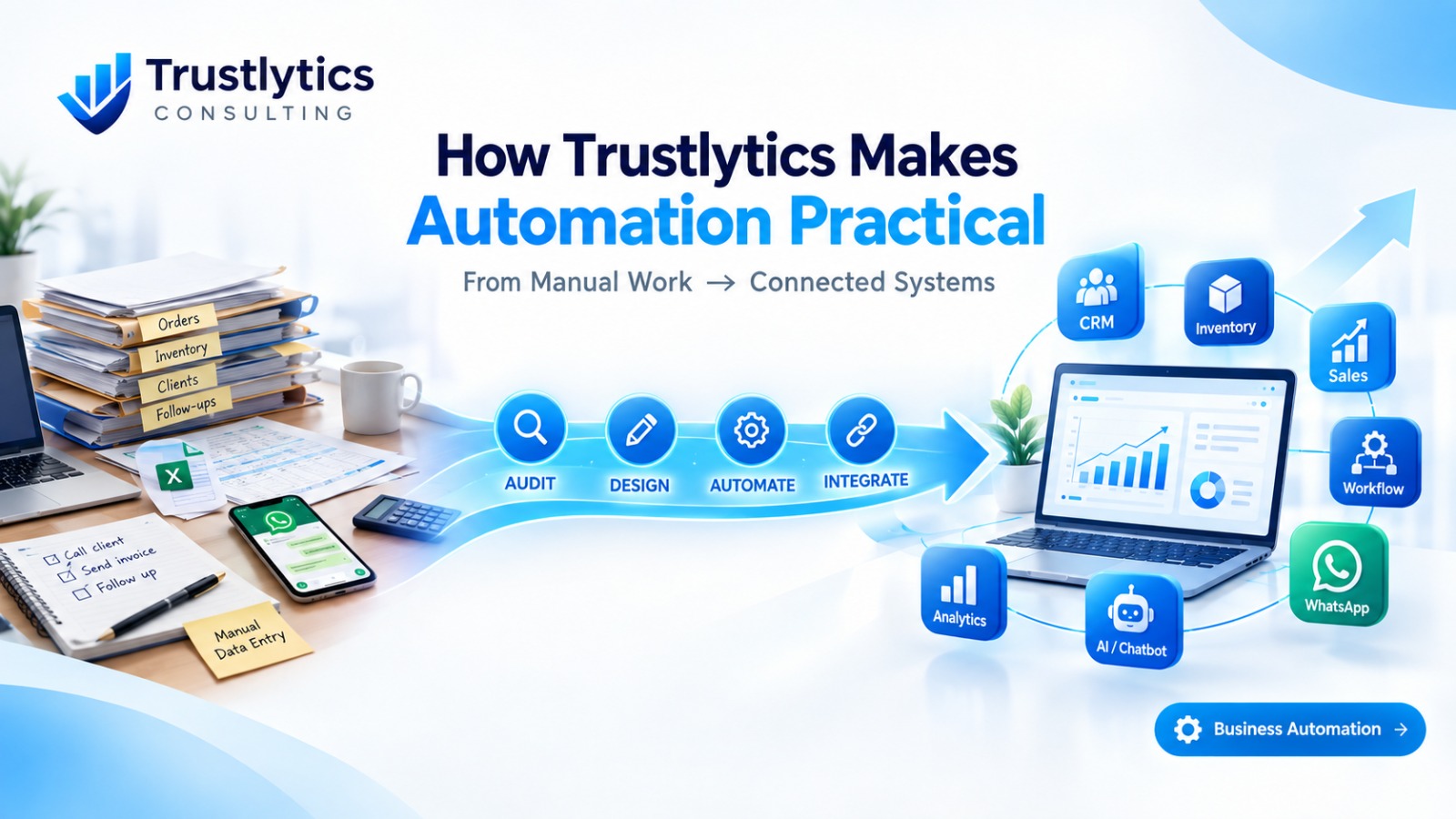
Custom-built dashboards and workflows. These cost more upfront to design and build, but they're shaped around how your business actually operates — not a template. For a growing MSME, this often ends up cheaper over a 2–3 year horizon, because you're not stacking per-user subscription fees indefinitely, and you're not paying repeatedly to bolt on features a generic tool never had. This is closer to how Trustlytics approaches automation — building dashboards for attendance, inventory, sales, customer tracking, and cash flow around your actual process, rather than selling you a rigid template and calling it a day.
Neither path is universally "right." A five-person shop that just needs basic billing probably doesn't need a custom build. A manufacturing unit juggling enquiries, order tracking, inventory, and staff attendance across three different Excel sheets almost certainly gets more value from something tailored — because the "cheap" generic tool starts costing more once you count the workarounds.
The Hidden Costs Nobody Mentions Upfront
If you take away one thing from this post, let it be this: the quoted price is rarely the final price. Here's what typically gets left out of the first conversation:
Data migration. Moving years of records out of Tally, Excel, or paper registers into a new system takes real time and real effort — and vendors don't always price this in clearly.
● Customization for edge cases. Your GST formats, your specific approval chains, your regional payment habits — none of this is "standard," and standard tools charge extra for it.
● Training your team. A dashboard nobody knows how to use is a very expensive Excel replacement. Budget time (and sometimes money) for this.
● Support when things change. GST rules update. Your product line grows. Your team doubles. A system that can't flex with you quietly becomes dead weight, and someone has to keep updating it.
● The cost of doing nothing. This one's harder to put a number on, but it's real — missed orders because a lead sat unanswered for two days, inventory mismatches discovered too late, staff attendance disputes that eat up an owner's Saturday. These costs don't show up on an invoice, but they show up in your margins.
So What Should a Small or Growing Business Actually Budget?
Given everything above, here's a realistic way to think about it rather than a single magic number:
If you just need basic tracking (billing, simple inventory, attendance) — expect a modest monthly software cost, likely in the low thousands per month, with light or no custom implementation.
● If you need connected systems (CRM + inventory + sales dashboards talking to each other) — expect a real implementation project, typically a one-time setup cost plus an ongoing monthly fee for the platform and support.
● If you're building something fully custom around your specific process — the upfront cost is higher, but you avoid the compounding per-user fees and repeated "extra module" charges that off-the-shelf platforms tend to add over time.
The honest, unglamorous truth is that automation that actually gets used and actually saves time tends to cost more than the cheapest option on the market — because the cheapest option usually skips implementation and training, and those are the parts that decide whether the tool gets adopted or abandoned in three months.
The Businesses That Wait the Longest Pay the Most
We built Trustlytics because most automation pricing in India is written for enterprises with dedicated IT teams and seven-figure budgets — not for a Howrah manufacturing unit or a Kolkata trading business trying to stop losing orders in the chaos of WhatsApp and Excel. Our Automate pillar is built around exactly the layers described above, made transparent from the start: no vague "contact us for pricing" followed by a surprise implementation bill.
We work with dashboard modules — HRMS for attendance and staff, CRM for customer and order tracking, inventory and warehouse management, financial tracking, and real-time KPI monitoring — and we build the combination that actually matches your business, rather than selling every module whether you need it or not. Because we work directly with growing businesses in the region rather than running a generic SaaS product, we can scope a system around your real process and be upfront about what it costs before you commit to anything.
Frequently Asked Questions
Need help improving your Business Automation & growing your business?
Automation was never really about technology for technology's sake. It was always about giving a business owner their time back, giving customers faster answers, and giving decision-making a foundation of real numbers instead of guesswork. Whether that business sits in Manhattan, Paris, or right here in Kolkata, the underlying need is the same — and for the first time, so is the access.
The businesses in America and France that automated early didn't have a secret advantage Kolkata businesses can't have too. They just started sooner. The good news is, that head start is no longer as far ahead as it used to be — and for the businesses in Howrah and Kolkata willing to make the move now, with a genuinely local partner like Trustlytics Consulting guiding the process, catching up might turn out to be the easy part. Staying ahead is where it gets interesting.
Get in touch with Trustlytics
Consulting for a free automation audit before this Independence Day