How Kolkata Businesses Are Using Automation — And Why the Rest of the World Is Watching Closely
How Kolkata Businesses Are Using Automation — And Why the Rest of the World Is Watching Closely
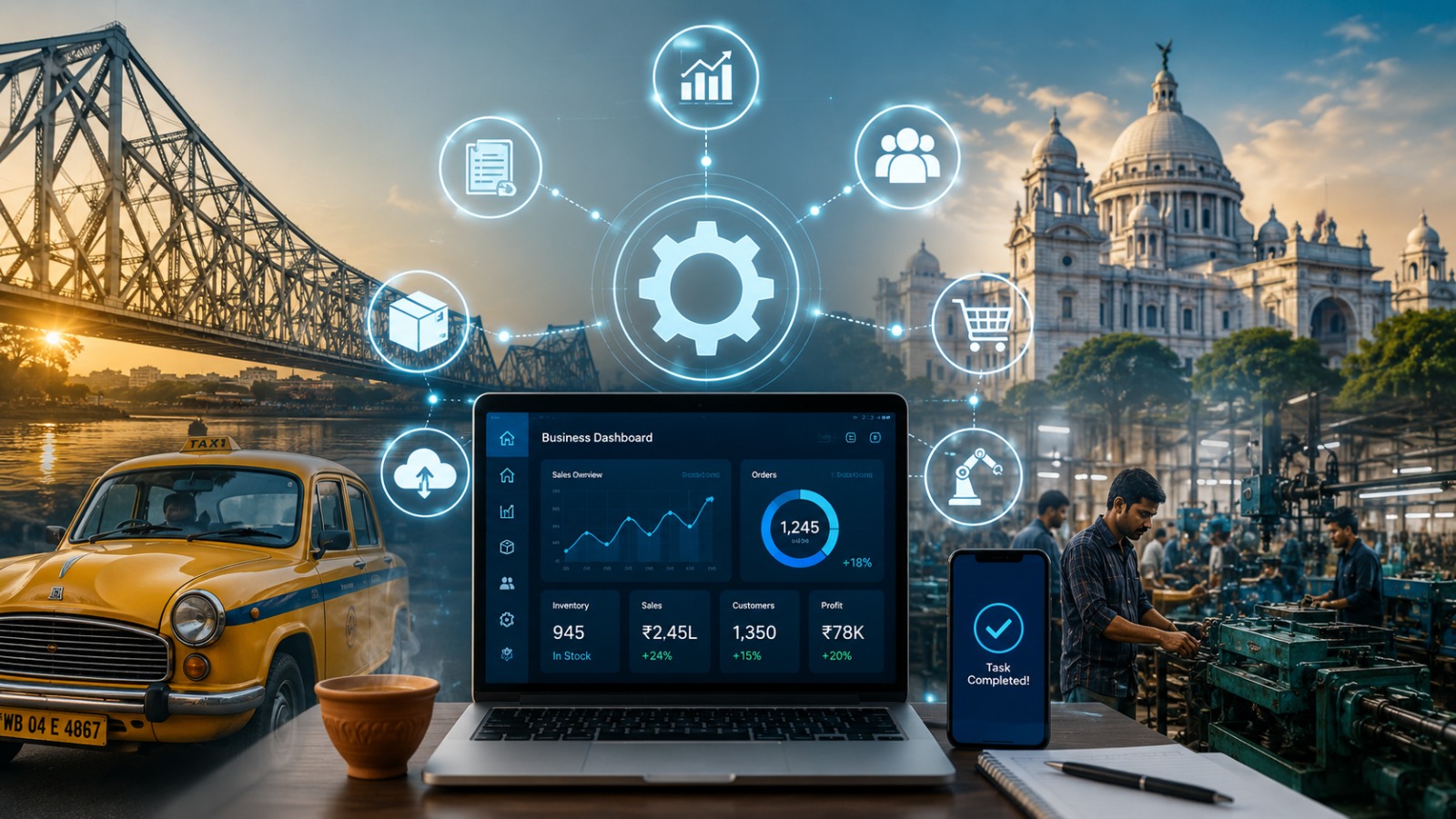
Walk into a small manufacturing unit in Howrah at 9 AM and you might see something you wouldn't have seen five years ago — no stacks of paper registers, no one manually calling up ten vendors to check stock. Instead, a dashboard glowing on a laptop screen tells the owner exactly what's moving, what's stuck, and what needs attention. Now fly 13,000 kilometers west to a mid-sized retail chain in New York, or a boutique fashion label in Paris, France, and you'll find the exact same story playing out — just with a different accent and a different currency. Automation has quietly become the one language every growing business, no matter where it sits on the map, is learning to speak fluently.
This isn't a coincidence. It's a pattern. And once you start noticing it, you can't unsee it.
The Global Shift Nobody Announced, But Everyone Joined
There was no press conference. No single company declared "the age of automation has begun." Yet here we are — the global business process automation market is projected to be worth over USD 22 billion in 2026, and it's expected to more than double by the early 2030s. Even more telling: nearly 9 out of every 10 organizations worldwide now use some form of automation in at least one part of their business, up sharply from just a few years ago. What started as a tool for giant corporations with dedicated IT departments has trickled down — fast — into small and medium businesses everywhere.
North America still leads the pack in total automation spending, largely because companies in the United States were among the earliest adopters of cloud-based tools and AI-driven workflows. But here's the twist that surprises most people: the fastest-growing region for automation adoption isn't the US or Western Europe anymore — it's Asia-Pacific, with small and medium businesses in India and China leading that charge. In other words, the businesses catching up the quickest aren't the ones in Silicon Valley boardrooms. They're the ones in cities like Kolkata, figuring out how to compete with the same tools, minus the venture capital.
Why Developed Countries Automated First — And What That Actually Taught Us
It's worth understanding why places like the US, France, Germany, or Japan got a head start. It wasn't because their businesses were smarter. It was because labor costs were higher, competition was fiercer, and customers expected faster service almost immediately. A retail store in Paris couldn't afford to have a customer wait three days for a stock update when a competitor two streets away could confirm availability instantly. A logistics company in Chicago couldn't survive on manual dispatch sheets when Amazon had already trained the entire market to expect same-day answers.
So businesses in developed economies automated out of necessity, and in doing so, they became an unintentional test lab for the rest of the world. They ironed out the mistakes — the clunky software, the overpriced enterprise tools that only Fortune 500 companies could afford, the six-month implementation timelines that scared away smaller players. What's left today, in 2026, is a much more mature, much more affordable version of that same technology. The tools that were once exclusive to companies with sevenfigure IT budgets are now available to a textile trader in Burrabazar or a foundry owner in Howrah, often for a fraction of the price and with none of the six-month wait.
That's the real story of global automation in 2026. It's not that Kolkata is "catching up" to the West. It's that the West already did the expensive experimenting, and now every MSME on the planet gets to skip straight to the useful part.
What Automation Actually Looks Like Inside a Kolkata Business
Strip away the buzzwords, and automation for a growing Kolkata or Howrah business usually comes down to a handful of very human problems finally getting solved.
Take inventory. Traders in Burrabazar have run tight margins for generations, and for just as long, stock mismatches have quietly eaten into profits — a few pieces missing here, an overstocked SKU there, nobody quite sure until the count happens weeks later. An automated inventory dashboard changes that overnight. Stock levels update the moment a sale happens, alerts go out before something runs out, and the owner isn't relying on memory or a dusty notebook anymore.
Or take customer follow-up. A manufacturing business might get fifty enquiries a month through calls, WhatsApp, and walk-ins — and without a system, at least a few of those always slip through the cracks. An enquiry management setup captures every single lead the moment it comes in, tracks where it is in the pipeline, and nudges the sales team before a hot lead goes cold. That's not a luxury feature anymore. That's the difference between closing a deal and watching a competitor close it instead.
Then there's the everyday grind — attendance tracking, payroll, expense logs, cash-flow visibility. These are the tasks that eat hours every single week without ever showing up as "growth" on paper. Automating them doesn't just save time; it gives an owner something more valuable — a clear, real-time picture of how the business is actually doing, instead of finding out at month-end that something went wrong three weeks ago.
The Same Playbook, Different Postcodes
Here's where it gets genuinely interesting. A café chain automating table orders and loyalty tracking in Kolkata is running almost the exact same playbook as a café chain doing it in London. A clinic in Salt Lake automating appointment bookings and patient reminders is solving the same problem a private practice in Toronto solved two years earlier. The tools look different, the price tags are wildly different, but the underlying logic — reduce manual work, respond faster than the customer expects, make decisions using real data instead of gut feeling — is identical everywhere.
This is exactly why automation has become such a leveling force for businesses outside the traditional "big city, big budget" mold. A small D2C fashion brand based out of Kolkata can, in theory, run customer service, order tracking, and marketing automation that's structurally no different from what a brand based in Paris or New York is running. The size of the business no longer dictates the sophistication of its systems — only the willingness to adopt them does.
And that willingness is exactly what's shifting right now across Howrah, Kolkata, and MSME hubs across India. Business owners who once saw automation as something "for big companies" are starting to realize it was never about company size. It was about whether you were tired enough of doing things the hard way to try doing them the smart way.
Where Trustlytics Consulting Fits Into This Story
This is precisely the gap Trustlytics Consulting was built to close. Founded on a simple, almost stubborn belief — that enterprise-grade systems shouldn't be locked behind enterprise-sized budgets — Trustlytics works with growing businesses across Howrah and Kolkata to bring them the same category of tools that global automation leaders have used for years, minus the bloated costs and the months-long onboarding.
Trustlytics' approach rests on three pillars: Automate, Build, and Market. On the automation side, that means dashboards covering everything from HR and attendance to inventory, sales, customer relationships, and real-time KPI tracking — built to fit how a Kolkata MSME actually operates, not repurposed from some template designed for a different market entirely. On the Build side, it means SEO-friendly websites that actually bring in enquiries instead of sitting idle. And on the Market side, it means the digital marketing and ad strategy that ensures all that new efficiency doesn't go unnoticed by the customers who need to find you.
What makes this different from simply buying software off a shelf is the local grounding. Trustlytics isn't a distant vendor selling a generic package and disappearing after installation — it positions itself as a longterm growth partner for the specific businesses of this region, the traders, manufacturers, clinics, and retailers who understand Howrah and Kolkata's markets better than any outsider ever could, but who've never had affordable access to the systems that let that local knowledge scale.
The Businesses That Wait the Longest Pay the Most
There's a quiet cost to sitting on the sidelines here, and it isn't always obvious until it's too late. Every enquiry that slips through an unmanaged WhatsApp inbox, every stock mismatch discovered too late, every hour spent manually compiling numbers that a dashboard could show instantly — these add up. Multiply that across a year, and the "cost of not automating" often turns out to be far higher than the cost of the software itself would have been.
Businesses in developed markets learned this the hard way over the last decade — the ones that automated early pulled ahead, and the ones that delayed spent years playing catch-up against competitors who were simply faster to respond, faster to fulfill, and faster to learn from their own data. That same window is open right now for businesses in Kolkata and Howrah. The tools have matured, the costs have dropped, and thebusinesses that move first will be the ones setting the pace for everyone else in their industry — not chasing it.
Frequently Asked Questions
Need help improving your Business Automation & growing your business?
Automation was never really about technology for technology's sake. It was always about giving a business owner their time back, giving customers faster answers, and giving decision-making a foundation of real numbers instead of guesswork. Whether that business sits in Manhattan, Paris, or right here in Kolkata, the underlying need is the same — and for the first time, so is the access.
The businesses in America and France that automated early didn't have a secret advantage Kolkata businesses can't have too. They just started sooner. The good news is, that head start is no longer as far ahead as it used to be — and for the businesses in Howrah and Kolkata willing to make the move now, with a genuinely local partner like Trustlytics Consulting guiding the process, catching up might turn out to be the easy part. Staying ahead is where it gets interesting.
Get in touch with Trustlytics
Consulting for a free automation audit before this Independence Day