How Growing Retail Businesses Use Social Media + Automation (And Why the Ones That Combine Both Are Winning in 2026)
How Growing Retail Businesses Use Social Media + Automation (And Why the Ones That Combine Both Are Winning in 2026)
Walk into any market in Howrah or Kolkata on a Saturday evening and you'll see two kinds of retail stores. One has a queue outside because a Reel about their new arrivals went mildly viral last week. The other is just as good — same quality, same prices, sometimes even a better location — but nobody outside the neighbourhood knows it exists.
The difference usually isn't budget. It's not even creativity. It's that the first store figured out how to combine social media marketing for retail business with a bit of automation, so their presence keeps working even when the owner is busy handling billing, staff, or a supplier call.
This blog breaks down exactly how growing retail businesses from apparel stores to grocery marts to home decor shops are using social media and automation together, what's actually working in 2026, and how you can start doing the same without hiring a ten-person marketing team.
Why Social Media Alone Isn’t Enough Anymore
A few years ago, posting consistently on Instagram or Facebook was the whole game. Post a product photo, add a caption, maybe boost it — done.
That's changed. India now has over 700 million social media users, and platforms like WhatsApp, Instagram, and Facebook have all evolved into shopping destinations, not just scrolling apps. WhatsApp alone has crossed 500 million users in India and is increasingly where customers expect to browse catalogues, ask questions, and even check out — not just chat.
That means two things for a retail business owner:
1. The audience is massive — bigger than any single physical store could ever reach.
2. The expectations are higher — customers want a reply in minutes, not days. A missed WhatsApp enquiry today is a sale that goes to a competitor tomorrow.
This is exactly where the phrase "social media marketing for small retail business" starts running into a wall. You can post great content, but if you're manually replying to every DM, manually posting at odd hours, and manually tracking which offer worked — you burn out long before your competitors do.
That gap is what automation is built to close.
What "Social Media + Automation" Actually Looks Like for a Retail Store
Let's get specific, because "automation" gets thrown around a lot without anyone explaining what it actually means for a real shop.
1. Scheduled, consistent posting (without sitting on your phone all day)
Retail sales are seasonal and time-sensitive — a festival collection, a weekend sale, a new stock drop. Automation tools let you plan a week or a month of posts in one sitting, so your social media content calendar for retail business runs on autopilot while you're busy on the shop floor.
This alone solves the single biggest reason small retail businesses go quiet on social media: not lack of ideas, but lack of time.
2. WhatsApp automation for instant replies and orders
This is probably the highest-impact change happening in Indian retail right now. WhatsApp automation for retail business typically includes:
● An instant auto-reply when a customer messages outside business hours, so they don't feel ignored
● A catalogue customers can browse directly inside WhatsApp
● Automated order confirmations and delivery updates
● Simple chatbot flows for FAQs like "Is this available in size M?" or "What's your store timing?"
For a store owner, this means fewer missed enquiries and faster response times — both of which directly affect conversion. Customers rarely wait around for a reply anymore; if two stores sell the same kurta, the one that replies in two minutes usually wins the sale.
3. Retargeting ads that bring window-shoppers back
Someone browsed your Instagram shop, liked three products, and left without buying. Without automation, that customer is gone. With a basic Meta Ads retargeting strategy for retail stores , that same customer sees a reminder ad a day or two later — often with the exact product they viewed — and comes back to complete the purchase.
This is one of the most cost-effective forms of paid advertising for local businesses because you're not paying to find a new audience; you're just following up with people who already showed interest.
4. Automated customer segmentation and follow-ups
Growing retail brands are starting to track who their repeat customers are, who bought once and disappeared, and who only buys during sales. Once you have this data (even in a simple dashboard), automation can send a gentle "we miss you" message or a birthday discount without you lifting a finger.
This is where customer retention automation for retail business quietly becomes more profitable than constantly chasing new customers — because a returning customer almost always costs less to sell to than a first-time one.
5. Performance tracking that doesn't need a spreadsheet marathon
Which post got the most enquiries? Which ad actually led to sales, not just likes? Automated reporting dashboards pull this together automatically, so decisions are based on numbers instead of guesswork like "that post felt like it did well."
Why This Combination Matters More for Retail Than Almost Any Other Business Type
Retail is unique in three ways that make social media + automation especially powerful:
● High purchase frequency — customers buy again and again, so retention automation compounds over time.
● Visual products — clothes, food, decor, electronics — all sell better with photos and video, which is exactly what social platforms reward.
● Impulse + urgency-driven buying — a well-timed post about limited stock or a flash sale converts browsers into buyers fast, but only if you can act on that urgency consistently, which is hard to do manually every single day.
Industry data backs this up: process automation for small businesses typically pays for itself within 6 to 12 months through time saved alone, before even counting the extra sales generated from faster response times and consistent posting. And on the marketing side, Meta's own advertising ecosystem has leaned hard into automated ad delivery and AI-assisted targeting, which is precisely why retail brands running even modest Meta Ads campaigns for retail business are seeing more efficient results than they would from manual, un-optimized boosting.
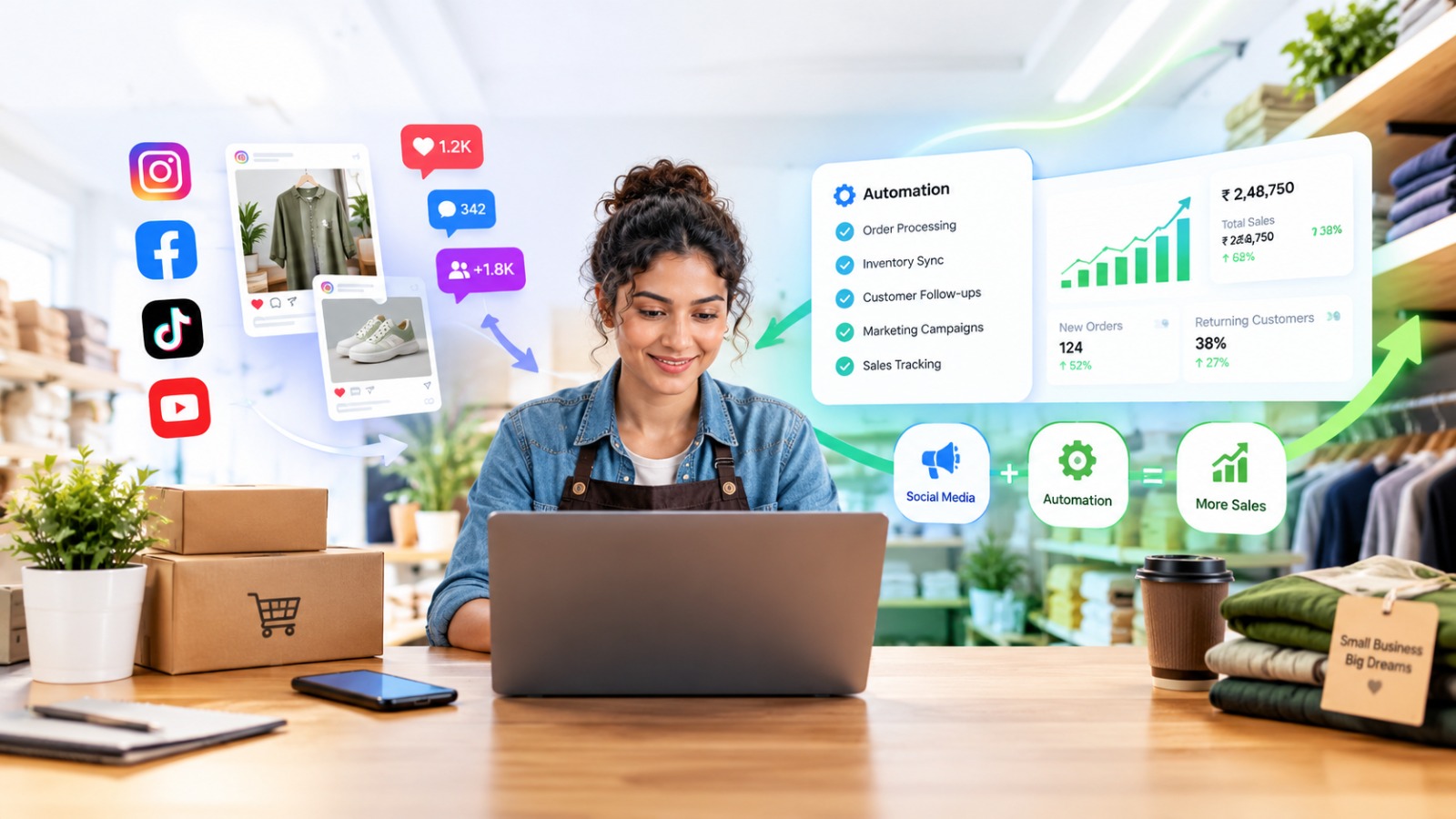
A Simple Way to Think About Getting Started
If all of this feels like a lot, here's the honest, non-overwhelming way to approach it:
Phase 1 — Fix the basics. Consistent posting (even 3–4 times a week), a complete Instagram/Facebook shop, and a WhatsApp Business profile with a catalogue.
Phase 2 — Automate the response layer. Set up WhatsApp auto-replies and quick FAQ automation so no customer enquiry goes unanswered for hours.
Phase 3 — Add paid visibility. A small, well-targeted Meta Ads budget aimed at people near your store or people who match your existing customers.
Phase 4 — Automate retention. Simple follow-ups, festival offers, and "we miss you" nudges to existing customers based on their purchase pattern.
Most retail businesses jump straight to Phase 3 (ads) without doing Phase 1 and 2 properly — which is why the ads don't convert as well as expected. Enquiries come in, but nobody replies fast enough, and the ad spend feels wasted. Getting the order right matters as much as doing each step well.
Common Mistakes Growing Retail Stores Make
Posting only when there's a sale. Customers start associating your page with discounts only, and ignore full-price posts.
● Treating WhatsApp as an afterthought. For most Indian retail buyers, WhatsApp is the actual point of decision-making — not Instagram.
● Running ads without a fast follow-up system. An enquiry that isn't answered within the hour has a much lower chance of converting into a sale.
● Never looking at the numbers. Without at least a basic dashboard, it's impossible to know which platform, post type, or offer is actually driving sales versus just driving likes.
Frequently Asked Questions
Need help improving your Business Automation & growing your business?
The retail businesses growing fastest right now aren't necessarily the ones with the biggest ad budgets or the flashiest content. They're the ones that stopped treating social media and automation as two separate, occasional tasks, and started treating them as one connected system — content going out consistently, enquiries being answered instantly, ads bringing back the customers who already showed interest, and a dashboard quietly keeping score of what's working.
If you're a retail business owner in Howrah or Kolkata and this sounds like exactly the gap in your current setup — content that goes out sporadically, WhatsApp enquiries that sit unanswered for hours, ad spend with no clear tracking — that's precisely the kind of setup Trustlytics Consulting works on with local retail brands: building the social media strategy, setting up the WhatsApp and Meta Ads automation, and putting a simple dashboard behind it so you can see, in real numbers, what's actually bringing customers through your door.
You don't need to overhaul everything overnight. Start with one piece — even just automating your WhatsApp replies — and build from there.