How Growing Coaching Centres Automate Student Leads (And Stop Losing Admissions to Slow Follow-Up)
How Growing Coaching Centres Automate Student Leads (And Stop Losing Admissions to Slow Follow-Up)
It's 7:40 PM on a Tuesday. A parent in Howrah is scrolling Instagram, sees an ad for a coaching centre's Class 10 batch, taps "Send Message," and types out a genuine enquiry — fees, timings, faculty, everything. Then she waits. The reply comes the next afternoon, because the frontdesk staff were busy handling walk-ins and the message got buried under forty others in the same inbox. By then, she's already spoken to two other coaching centres and enrolled her son in one of them.
This isn't a rare story. It's the default outcome for most coaching institutes in India today, and it's one of the biggest reasons growing centres plateau instead of scaling. The teaching might be excellent. The results might be genuinely strong. But if the enquiry-to-admission process is manual, scattered across WhatsApp, phone calls, and a notebook at the reception desk, a coaching centre is quietly leaking students every single month — and rarely even realizes it.
Coaching Is a Bigger Business Than It Looks
The Indian coaching industry isn't a cottage business anymore. Industry estimates from IMARC Group put the coaching institutes market in India at around USD 7.2 billion in 2025, with projections of continued double-digit annual growth through the next decade as competition for entrance exams, board results, and skill-based courses keeps intensifying. Online and hybrid coaching is growing even faster than offline, driven by parents who now expect the same speed and convenience from a coaching centre that they get from any other service they book on their phone.
That last part matters more than most institute owners realize. Parents today are comparing coaching centres the way they compare food delivery apps — whoever responds fastest, explains clearly, and feels the most "put together" usually wins the admission, even before a single class is taught.
The Real Cost of a Slow Enquiry Process
This isn't just intuition — it's backed by consistent research on how buyers behave after they enquire. Multiple lead-response studies, including the widely cited MIT/Harvard Business Review research on sales leads, have found that contacting a new enquiry within the first five minutes makes you dramatically more likely to actually connect with that person compared to waiting even thirty minutes, and the odds of qualifying that lead drop sharply the longer the delay stretches. Separate data from CRM and sales-tech researchers points to a similar pattern: a large share of customers end up going with whichever business responds to them first, regardless of who has the better offering.
Now map that onto a real coaching centre. Admission season means dozens of enquiries a day, arriving through Meta ads, Google searches, walk-ins, referrals, and WhatsApp forwards — all at once. A front desk team, however capable, physically cannot give every single one of those enquiries an instant, consistent, well-informed reply. Something always slips. And every enquiry that slips is a seat that could have gone to a competing coaching centre down the road.
What "Automating Student Leads" Actually Means
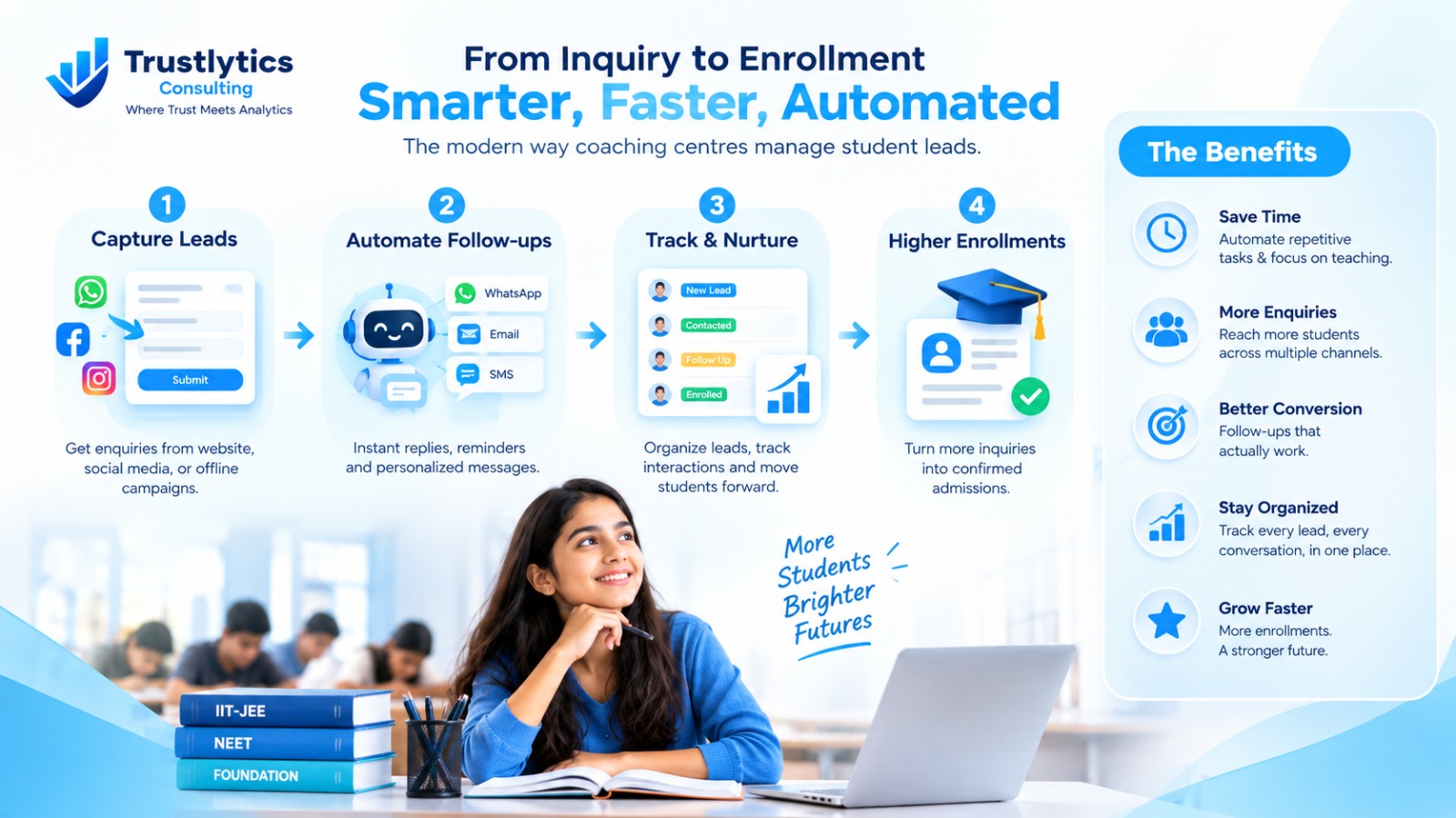
Automation doesn't mean replacing your counsellors and teachers with chatbots. For a coaching centre, it means making sure no enquiry ever sits unanswered, no follow-up gets forgotten, and every staff member knows exactly who to call and when — without anyone having to manually track it in a register or a dozen WhatsApp chats. In practice, a proper student lead automation system for a coaching centre usually covers six things:
1. Capturing every enquiry in one place.Whether a student fills a form on your website, messages you on Instagram, comments on a Meta ad, or calls the front desk, the enquiry should land in a single Enquiry Management System (EMS) instead of being scattered across five different apps and phone numbers.
2. Instant automated first response.The moment an enquiry comes in — even at 11 PM — an automated WhatsApp or SMS message acknowledges it, shares batch timings, fees, or a brochure, and tells the parent when a counsellor will call. This alone protects you from the "first responder wins" problem described above.
3. Lead scoring and qualification. Not every enquiry is equally serious. A good system can flag which leads are asking about fees and admission dates (hot) versus which are just browsing (cold), so your counselling team spends their calling time where it actually converts.
4. Automated nurture sequences.A parent who enquired but hasn't enrolled yet doesn't need one follow-up call — they need a structured sequence: a reminder about a demo class, a testimonial from a topper, a limited-seats nudge, spread over days, sent automatically via WhatsApp or SMS without anyone having to remember to do it manually.
5. Task and follow-up routing for staff.Instead of a counsellor guessing who to call next, the system assigns and reminds — "Call Riya's parent back today, she asked about the NEET batch two days ago." Nothing falls through the cracks because a staff member forgot.
6. A dashboard that shows what's actually working.Which ad, which batch, which referral source is bringing in students who actually enrol? Without this visibility, most coaching centres keep spending marketing budget on channels that generate enquiries but not admissions.
Why This Matters More for Growing Coaching Centres, Specifically
A single-branch, well-known coaching centre with a strong local reputation can survive on word of mouth and a slow front desk. A growing coaching centre — one that's opening a second batch, a second subject, or a second branch, and is actively running Meta ads or Google campaigns to build a name for itself — cannot afford that same slack.
Growth brings volume, and volume is exactly where manual enquiry handling breaks down. The centres that scale successfully are almost always the ones that put a lead automation system in place before the enquiry volume becomes unmanageable, not after they've already lost a season's worth of admissions figuring it out the hard way.
How Trustlytics Consulting Helps Coaching Centres Automate This
This is precisely the gap Trustlytics Consulting works on with coaching centres and educational institutes in the Howrah and Kolkata region. Trustlytics builds a centralised Enquiry Management System dashboard that pulls in leads from your website, Meta Ads, and WhatsApp into one place, sets up automated instant-response and follow-up sequences so no enquiry goes cold, and pairs it with a Customer/Student CRM so counsellors always know exactly who to call and what was already discussed.
On top of the automation layer, Trustlytics also builds SEO-friendly websites with enquiry forms designed to actually convert visitors into leads, and runs Meta Ads campaigns targeted at parents actively searching for coaching in your subject and city — feeding directly into the same automated enquiry system, so the leads you pay for don't go to waste sitting unanswered.
For a coaching centre owner, the pitch is simple: you and your teaching staff focus on results in the classroom; the enquiry-to-admission pipeline runs on a system that doesn't forget, doesn't get overwhelmed during peak season, and doesn't quietly lose parents to a faster-responding competitor.
Getting Started: A Practical Checklist
If you're running a coaching centre and want to know whether you actually need this, ask yourself honestly:
Do you know, right now, how many enquiries you got this week and where they came from?
Does every enquiry get a reply within minutes, at any hour, even outside office hours?
If a parent enquired but didn't enrol, is there a structured follow-up plan, or does it depend on someone remembering? Can you tell which marketing channel — Meta ads, Google, referrals — is actually converting into admissions, not just enquiries?
If the honest answer to any of these is "no" or "not really," that's not a staffing problem. It's a systems problem, and it's the exact gap that student lead automation is built to close.