AI Chatbots vs Human Support: What Growing Businesses Actually Need
AI Chatbots vs Human Support: What Growing Businesses Actually Need
Picture this: it's 11 PM, a potential customer is stuck on your checkout page, and your support team went home hours ago. Do they wait until morning, or do they bounce to a competitor who answers instantly? This exact scenario plays out thousands of times a day across growing businesses, and it's why the debate around AI chatbots vs human customer support has become one of the hottest conversations in the customer service industry.
If you're running a growing business, you've probably already asked yourself this question. Should you invest in an AI-powered chatbot solution to handle customer queries round the clock? Or is human customer support still the safer bet for building trust and loyalty? The honest answer isn't as black-and-white as most articles make it sound — and that's exactly what we're going to unpack here.
The Rise of AI Chatbots in Customer Service
Let's start with the obvious. AI chatbots have exploded in popularity, and for good reason. A well-built AI customer service chatbot can handle hundreds of conversations simultaneously, respond in seconds, and never call in sick. For businesses scaling fast, this kind of 24/7 customer support automation feels like a dream come true.
Think about the sheer cost efficiency. Hiring, training, and retaining a full human support team is expensive — salaries, benefits, shift management, and the constant churn of employee turnover all add up. An AI chatbot, on the other hand, is a one-time (or subscription-based) investment that scales without proportionally increasing your costs. This is precisely why conversational AI for business has become a top priority for startups and SMEs looking to optimize their customer support budget .
Modern AI chatbot platforms are also genuinely smart now. They can pull data from your CRM, answer FAQs with pinpoint accuracy, guide users through troubleshooting steps, and even upsell products based on browsing behavior. For repetitive, high-volume queries — "Where's my order?", "What's your return policy?", "Do you ship internationally?" — chatbots are hard to beat. They reduce average response time , cut down on support ticket backlog , and free up your human agents to focus on complex, high-value conversations.
But Here's Where It Gets Tricky
Now, here's the part most "AI is the future" articles conveniently skip over. Chatbots are brilliant at structured, predictable interactions. They fall apart the moment a conversation gets emotional, ambiguous, or nuanced — which, let's be honest, is a huge chunk of real customer support.
Ever tried explaining a complicated billing dispute to a chatbot that keeps looping you back to the same three canned responses? Frustrating, right? That frustration has a name in the industry: chatbot fatigue . And it's a silent conversion killer. Customers who feel unheard by a bot don't just get annoyed — they often abandon the brand altogether, taking their customer lifetime value with them.
This is where human customer support still holds its ground, and honestly, always will. Humans bring empathy, contextual judgment, and the ability to de-escalate a frustrated customer in ways no algorithm can replicate — at least not yet. When a customer is angry about a delayed shipment affecting their business, or confused about a subscription cancellation policy, they don't want a scripted response. They want to feel heard. That emotional intelligence is what drives customer retention and turns one-time buyers into loyal, repeat customers who leave five-star reviews and refer their friends.
There's also the trust factor. For high-ticket purchases, B2B sales conversations, or anything involving sensitive financial or personal information, customers still overwhelmingly prefer talking to a real person. It's a credibility signal — and for growing businesses trying to establish themselves in a competitive market, that human touchpoint can be the difference between a closed deal and a lost lead.
So, Which One Should Growing Businesses Actually Choose?
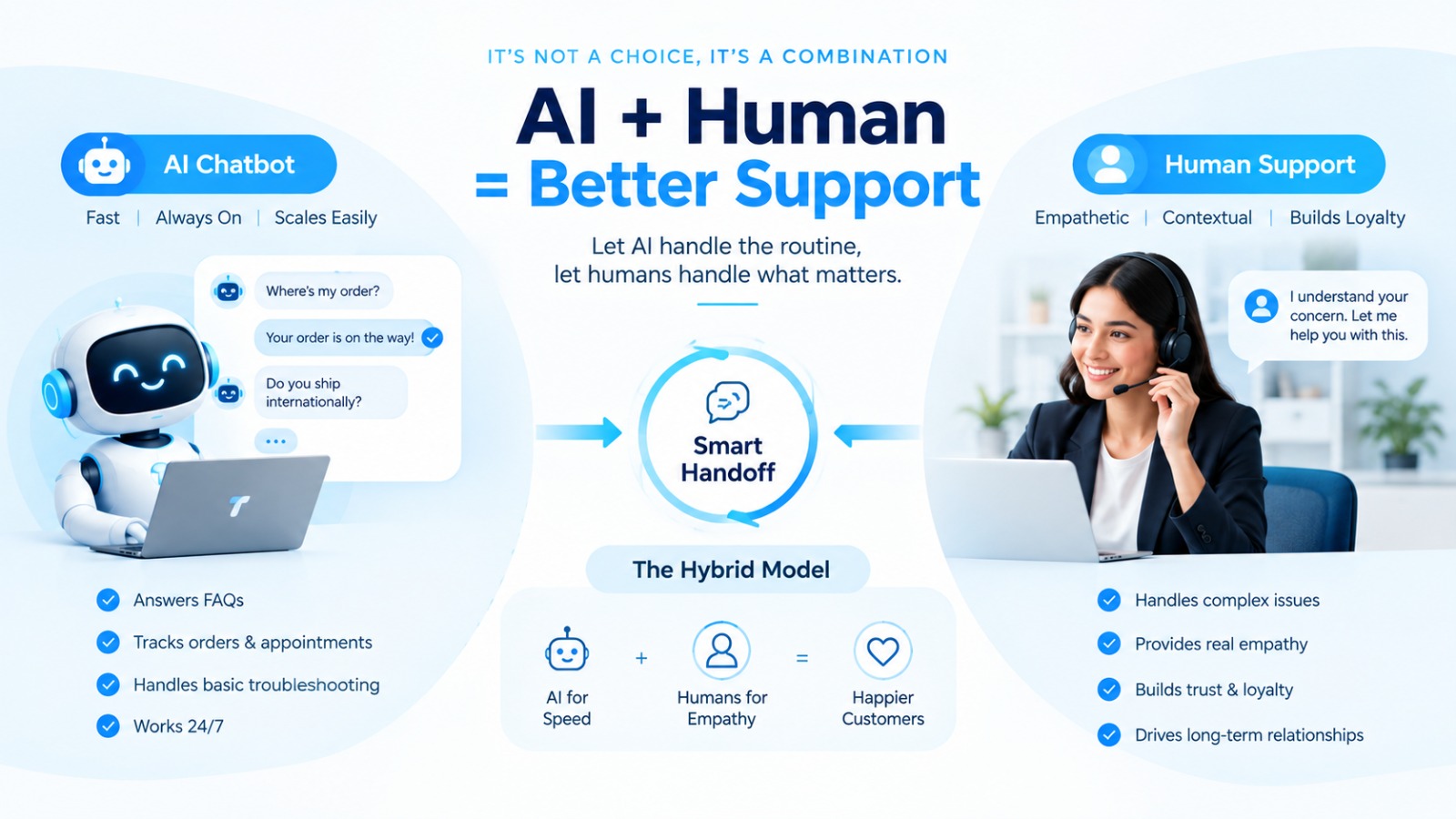
Here's the truth nobody wants to say out loud: it's not really "AI chatbots vs human support." That framing is a false choice. The smartest, fastest-growing businesses aren't picking a side — they're building a hybrid customer support model that plays to the strengths of both.
Think of it like this. Let your AI chatbot be the friendly, tireless first responder — handling FAQs, order tracking, appointment scheduling, and basic troubleshooting instantly, any time of day. Then, the moment a conversation shows signs of complexity, frustration, or high stakes, it should seamlessly hand off to a trained human agent. This is called intelligent escalation , and it's quickly becoming the gold standard for customer experience management in 2026.
This hybrid approach gives you the best of both worlds: the operational efficiency and cost savings of automation , combined with the emotional intelligence and trust-building of human interaction . Businesses that get this balance right consistently report higher customer satisfaction scores (CSAT) , better Net Promoter Scores (NPS) , and stronger long-term brand loyalty compared to those who go all-in on either extreme.
The Real Challenge: Knowing Where to Draw the Line
Okay, so a hybrid model sounds great in theory. But how do you actually figure out which queries should go to bots and which need a human? This is where most growing businesses get stuck — and honestly, where most of them get it wrong. Automate too much, and you alienate customers with a robotic, impersonal experience. Automate too little, and you're bleeding money on avoidable support costs while your competitors move faster.
This is exactly the kind of strategic decision that benefits from expert guidance rather than guesswork. This is where a firm like Trustlytics Consulting comes into the picture. Rather than randomly picking a chatbot tool off the internet and hoping for the best, businesses working with experienced customer experience consultants can map out exactly which touchpoints in their customer journey are ripe for automation and which absolutely need a human voice. Trustlytics Consulting specializes in helping growing businesses design data-driven customer support strategies — analyzing your existing support tickets, customer behavior patterns, and industry benchmarks to build a support model that's tailored to your business rather than a one-size-fits-all template. That kind of strategic input often saves businesses months of trial and error (and a fair number of unhappy customers along the way).
What Growing Businesses Should Actually Prioritize
If you're at that stage where your business is scaling and your current support setup — whether that's a tiny team or an overwhelmed inbox — just isn't cutting it anymore, here's what actually matters:
Independence, for a business owner, doesn't always look like a flag on a rooftop. Sometimes
it looks like:
Start with your data. Look at your most common customer queries. If 60-70% of your tickets are repetitive and low-complexity, that's your automation opportunity right there.
Don't skimp on the handoff experience. A bad bot-to-human transition — where the customer has to repeat everything they already said — is worse than no automation at all.
Invest in training, whichever path you choose. Chatbots need constant fine-tuning based on real conversations. Human agents need ongoing training in empathy, product knowledge, and de-escalation techniques.
Measure what matters. Track resolution time, customer satisfaction, and repeat contact rates — not just how many tickets you've closed. Speed without satisfaction is a hollow win.
Think long-term, not just short-term savings. Yes, chatbots are cheaper upfront. But if they're driving customers away, the "savings" are an illusion. Real ROI comes from customer lifetime value , not just cost-per-ticket.
Frequently Asked Questions
Need help improving your Business Automation & growing your business?
There's no universal winner in the AI chatbots vs human support debate — and honestly, anyone telling you otherwise is probably selling something. What growing businesses actually need isn't a decision between technology and humanity; it's a thoughtful, well-designed blend of both, built around how your specific customers actually behave and what they actually value.
The businesses winning right now aren't the ones with the flashiest chatbot or the biggest support team. They're the ones who've figured out the right rhythm between automation and human connection — and who treat customer support not as a cost center, but as a genuine growth lever. If you're not sure where that balance lies for your business yet, that's completely normal — it's exactly the kind of problem worth bringing in outside expertise for, whether that's through structured customer experience audits or working with specialists like Trustlytics Consulting to build a roadmap that fits your growth stage.
Because at the end of the day, customers don't care whether they're talking to a bot or a human. They care whether their problem got solved — fast, and with a little bit of care along the way.