7 Signs Your Business Is Bleeding Money Without Automation
affordable-business-process-automation-services-kolkata-independence-day-offer
Money doesn't usually leave a business through the front door. It slips out the back — through the fifteen minutes an employee spends copy-pasting data between spreadsheets, the follow-up email that never got sent, the invoice sitting in a "pending" folder for three weeks. None of these things trigger an alarm. But add them up over a quarter, and you're often looking at a leak big enough to fund a whole new hire.
That's the uncomfortable truth about running a business without automation in 2026: you don't see the loss on a single day's balance sheet. You see it in slower growth, tired teams, and margins that never quite match what the spreadsheet promised. If you've been wondering why your revenue looks healthy but your profit doesn't feel like it, here are seven signs your business is quietly bleeding money — and why business automation, guided by the right partner, might be the fix you've been putting off.
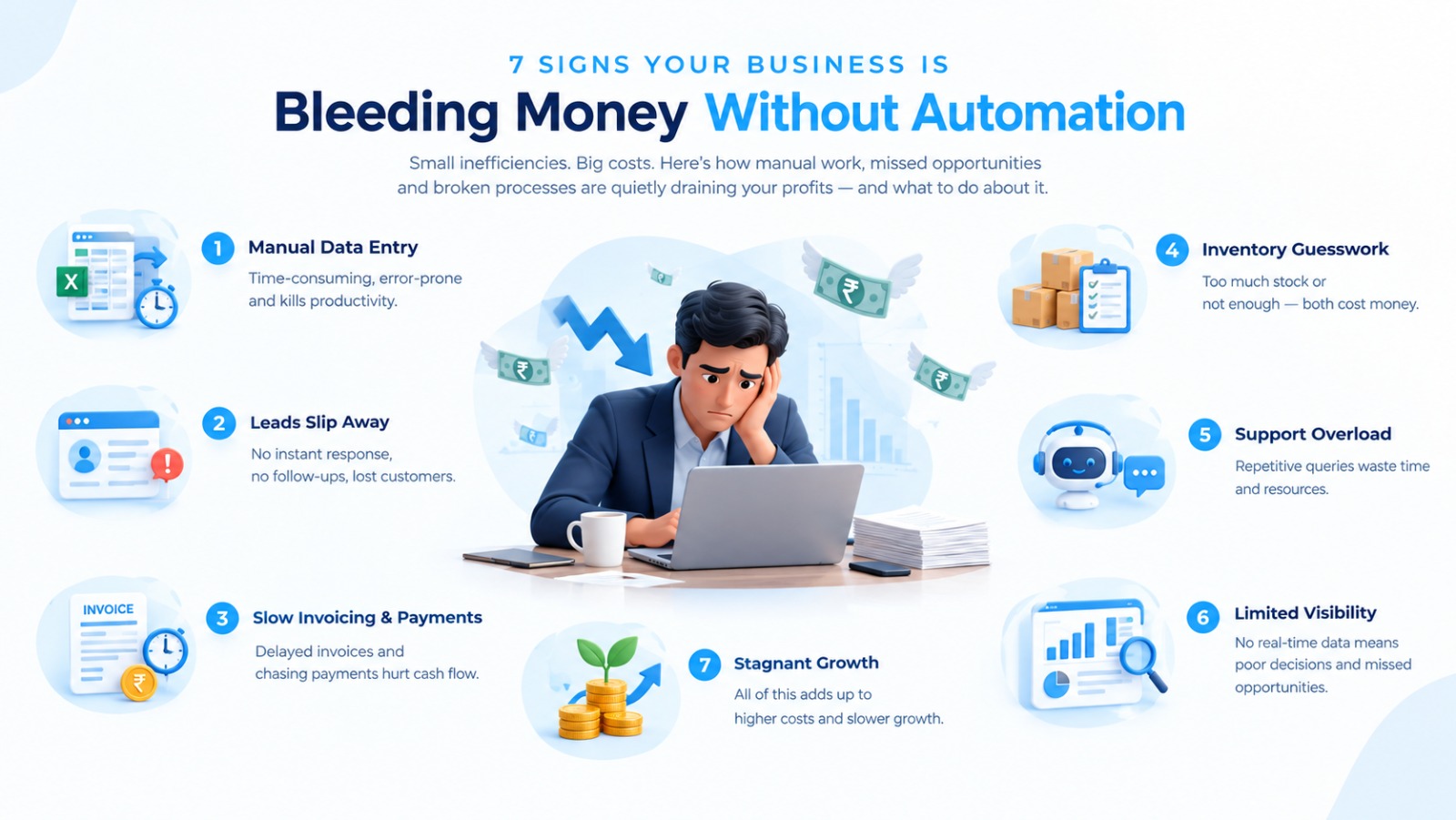
Your Team Is Drowning in Manual Data Entry
Ask yourself honestly: how much of your team's day goes into typing the same information into two, three, or four different systems? Sales enters a lead into a spreadsheet. Someone else re-enters it into the CRM. Finance re-enters it again for invoicing. Every re-entry is a chance for a typo, a missed field, or a duplicate record — and every minute spent typing is a minute not spent selling, serving customers, or solving actual problems.
This is one of the clearest signs that business process automation isn't optional anymore. Workflow automation tools can sync data across your CRM, accounting software, and project management systems in real time, without a single human touching a keyboard twice. Companies that automate this one function alone often report saving dozens of labor hours every month — hours that go straight back into revenue-generating work. .
Leads Are Falling Through the Cracks
Here's a scenario every sales manager knows too well: a hot lead fills out a form on your website, and then... nothing happens for two days. By the time someone finally calls, the prospect has already booked a demo with a competitor. That delay isn't a people problem — it's a systems problem.
Without automated lead routing and follow-up sequences, even the best sales team can't respond fast enough to match customer expectations. CRM automation ensures every inquiry gets an instant acknowledgment, gets assigned to the right rep automatically, and triggers a follow-up reminder so nothing sits untouched. If your close rate feels lower than it should be given your traffic, this is very likely where the money is disappearing.
Invoicing and Payments Take Forever
Cash flow problems rarely come from a lack of sales. More often, they come from how long it takes to turn a completed sale into cash in the bank. If your team is manually generating invoices, chasing payments through phone calls, and reconciling bank statements by hand, you're not just wasting time — you're extending your own payment cycle and quietly financing your customers for free.
Automated invoicing and billing systems send invoices the moment a job is marked complete, follow up automatically on overdue payments, and sync directly with your accounting software. Businesses that automate this step typically see their average collection period shrink significantly, which does wonders for cash flow without changing a single thing about how much you're selling.
Inventory and Stock Levels Are a Constant Guessing Game
For product-based businesses, this is where automation quite literally saves your bank balance. Overstocking ties up capital in shelves nobody's buying from. Understocking means lost sales and frustrated customers who go elsewhere. Both problems usually trace back to the same root cause: inventory tracking that still relies on manual counts and gut instinct.
Automated inventory management systems update stock levels in real time across every sales channel, flag reorder points before you run out, and forecast demand based on actual purchase history rather than guesswork. If your warehouse or storeroom often surprises you — in either direction — this is a sign your business is bleeding money that automation could plug almost immediately.
Customer Support Feels Like a Never-Ending Fire Drill
If your support team spends most of the day answering the same handful of questions over and over, you're not running a support team — you're running an expensive FAQ page. Every repetitive query that a human has to answer manually is time taken away from complex issues that actually need a human touch, and it's a direct hit to your operational efficiency.
Chatbots, automated ticketing systems, and self-service knowledge bases handle the repetitive 60–70% of queries instantly, 24/7, without needing a coffee break. This doesn't just cut costs — it improves customer satisfaction, because people get answers in seconds instead of waiting in a queue. A business bleeding money on oversized support headcount is often just a business that hasn't automated its Tier 1 support.
Decision-Making Is Based on Outdated Reports
How current is the data your leadership team is looking at when they make a big call? If the honest answer is "the report someone pulled together last Friday," you have a problem. Manual reporting means someone has to gather data from five different tools, clean it up in Excel, and present it — usually days after the numbers actually mattered.
Automated dashboards and reporting tools pull live data from every system you use and present it in real time. This means you catch a dip in conversion rates the day it happens, not three weeks later when the damage is already baked into the quarter. Slow, manual reporting doesn't just waste time; it costs you the chance to course-correct early, which is often the most expensive kind of money leak because it's invisible until it's too late.
Your Best Employees Are Burning Out on Busywork
This last one doesn't show up on a spreadsheet at all, but it might be the most expensive sign on this list. When talented employees spend their days on repetitive, low-value tasks — manually formatting reports, chasing approvals, updating spreadsheets — two things happen. First, they get less done. Second, they start looking for a job where their skills are actually used.
Replacing a skilled employee is expensive: recruiting costs, onboarding time, lost institutional knowledge, and a productivity dip that can last months. Business automation doesn't replace people; it removes the tedious work that makes good people want to leave. A well-automated workflow lets your team focus on strategy, creativity, and relationships — the things a machine genuinely can't do, and the things that actually grow a business.
Your Best Employees Are Burning Out on Busywork
Here's the thing about all seven of these signs: none of them require a massive tech overhaul to fix. Most businesses don't need to rebuild their entire operation from scratch — they need the right processes identified, prioritized, and automated in the correct order, starting with whichever leak is costing the most.
That's exactly where a lot of businesses get stuck. They know automation is the answer, but figuring out which tools to use, how to integrate them with existing systems, and how to roll them out without disrupting daily operations feels overwhelming. This is precisely the gap that automation consulting exists to close.
Trustlytics Consulting works with growing businesses to map out exactly where money is quietly leaking — whether it's manual data entry, slow invoicing, disconnected sales and support systems, or outdated reporting — and builds a practical, phased automation roadmap around it. Instead of throwing every tool at the problem at once, Trustlytics Consulting focuses on high-impact automation first: the fixes that free up cash flow and team hours fastest, so the investment pays for itself quickly rather than sitting as a line item you have to justify later.
Frequently Asked Questions
Need help improving your Business Automation & growing your business?
Every month you delay automating a leaky process is another month of paying for it — in wasted hours, missed leads, delayed cash, and employees who are one bad week away from updating their resume. Automation isn't about replacing your team or chasing the latest tech trend. It's about making sure the money your business earns actually stays in your business.
If any of these seven signs sounded a little too familiar, it might be worth having a conversation with a team that's seen this pattern before. Trustlytics Consulting can help you spot exactly where your business is losing money — and, more importantly, help you fix it before another quarter slips by.